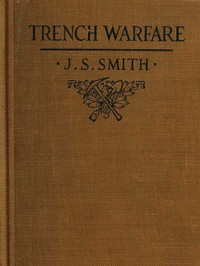
Trench Warfare: A Manual for Officers and Men — Context and Discussion
Edition facts
The manual opens with a blunt assessment: the German army's initial plans for a swift victory collapsed, forcing a new kind of warfare. Smith, a second lieutenant with the British Expeditionary Force, writes from fifteen months on the Belgian and French fronts, both as a private and an officer. He does not claim expertise; instead, he offers a “basic foundation” for further learning, acknowledging that trench warfare changes daily and that mistakes on the Western Front are rarely recoverable. The tone is practical, almost weary, and the reader is immediately placed in a world where pick-and-shovel work rivals the Panama Canal in scale.
The Author’s Ground-Level Authority
Smith’s preface establishes his credibility through specific service details: thirty-one months total, fifteen in the trenches, and experience in both enlisted and officer roles. He explicitly states that his notes come from “different courses of instruction” and direct observation, not from theoretical study. This grounding matters because the manual repeatedly warns against rigid rules. For instance, Smith notes that the British retreat from Mons exposed the inadequacy of pre-war trench-digging doctrine—the standard “hole” offered no protection from overhead shrapnel. By framing his advice as provisional, he invites the reader to treat the text as a starting point rather than a final authority.
Drainage as a Central Problem
A substantial portion of the excerpts focuses on water management, suggesting that mud was as formidable an enemy as the opposing army. Smith describes drainage gullies at least 18 inches wide, sump-pits dug 10 feet below trench level, and the use of “trench patrols” or maintenance squads to clear blockages. He emphasizes that even a ridge of mud from a footprint can disable a sump-pit. The level of detail—down to the dimensions of side sump-pits (6 feet deep, 4 feet in diameter) and the recommendation to use multiple small pumps rather than one large one—reflects a hands-on understanding of daily trench maintenance. The reader is left with a vivid sense of the physical labor required to keep a trench functional.
The Limits of Written Instruction
Smith repeatedly underscores what his book cannot do. He writes that “for obvious reasons” he cannot give certain information, and he cautions that no cut-and-dried rule applies because trench warfare evolves constantly. This restraint is unusual for a manual; it acknowledges the gap between text and reality. For example, when discussing pumps, he notes that they “hardly repay the fatigue entailed in getting them to the trenches.” Such frank admissions suggest that the manual’s value lies not in providing a complete system, but in alerting the reader to the kinds of problems—and the kinds of improvisation—they will face. The tone is that of a seasoned soldier speaking to a novice, not a lecturer.
Structural Clues from the Excerpts
Though the excerpts are incomplete, they reveal a clear organizational pattern. The manual begins with an introduction that sets the historical context (the retreat from Mons) and the author’s credentials. It then moves into technical chapters: the drainage section is detailed and prescriptive, with numbered dimensions and warnings. Later sections appear to cover floorboards and other trench fittings. The presence of a sketch (referenced but not included) indicates that Smith relied on visual aids. The text’s structure—historical context, then practical instructions, then maintenance—suggests a logical progression from why trenches are built to how they are kept habitable. A first-time reader should expect a blend of narrative and technical exposition.
Smith’s manual is best approached as a field notebook rather than a definitive guide. The reader should pay attention to the dimensions and procedures, but also to the author’s asides about what cannot be taught. The excerpts suggest that the book’s real subject is the gap between theory and practice—a gap that Smith, through his own experience, tries to narrow. For those interested in the material culture of World War I, this text offers a rare, unvarnished look at the daily challenges of trench life.