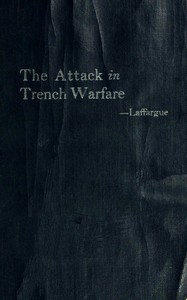
The Attack in Trench Warfare: Impressions and Reflections of a Company Commander — Background and Themes
Edition facts
Captain André Laffargue’s study opens by declaring that the attack has become “one of siege warfare,” a blunt redefinition of infantry tactics for the static fronts of World War I. Writing as a company commander in the 153rd Infantry, he grounds every observation in the physical realities of the trench line: the depth of enemy defenses, the distance to the opposing parapet, the need to break through “several lines of defense upon a depth of about three kilometres.” His prose moves between crisp tactical prescription and a quieter attention to the mental state of soldiers—what he calls “the appeal for a supreme resolution to their inner selves.”
The Geometry of the Assault
Laffargue structures his attack around precise distances and phases. He distinguishes between a “long-distance assault” launched from 150 metres and a longer approach from 500 metres, each requiring different formations and fire plans. In the first case, he prescribes a rush of 80 metres by echelon, with men ordered to “hide your bayonets” before the signal. In the second, he advocates “short, rapid rushes without firing, in thin lines” that consolidate at assaulting distance. The recurring image is one of measured movement: the company advances not as a wave but as a series of deliberate, coordinated bounds, each step calculated to minimize exposure while maintaining momentum.
Fire, Silence, and the Best Shots
A central tension in Laffargue’s method is between noise and precision. He warns that “firing unnerves and distracts the noncommissioned officers and soldiers” and insists that “silence is at once a mark of order.” To gain fire superiority, he recommends designating the best shots to fire “obliquely” from behind improvised masks, picking off enemy soldiers one by one until the opposing trench “seems as if it were empty.” This slow, deadly fire contrasts with the “noisy and not particularly effective” alternative of mass volleys. The emphasis on individual marksmanship and concealment reflects a tactical culture that values discipline over volume.
The Second Line and the Spirit of Decision
Laffargue devotes significant attention to troops of the second line, who must be ready to exploit a breach or renew an assault. He argues that these units should have “only one idea: to assault as soon as possible” and must be trained to create “a sort of parallel of departure at assaulting distance” while achieving fire superiority. He recommends developing “presence of mind by inventing sudden incidents requiring the taking of a rapid decision.” The language here shifts from mechanical instruction to a concern with morale and initiative—what he calls “adding a spirit of prompt decision” to the élan of the assault troops. The second line is not a reserve but a dynamic force for exploitation.
Order Amid Disorder
Throughout the excerpts, Laffargue returns to the problem of disorder. He notes that when men are crowded into uncomfortable positions and units become mixed, “these are conditions likely to create disorder, the worst enemy of the assault.” His remedies are concrete: transmit orders by note, have men cease firing except the best shots, and enforce silence. The company commander’s voice is that of a practical leader who has seen how quickly cohesion dissolves under fire. He advises that “think well as long as you are under cover because amid the bullets you march straight ahead without thinking”—a striking acknowledgment that rational planning must occur before the chaos of the assault.
Laffargue’s text is best read as a field manual shaped by immediate experience, not a theoretical treatise. The reader should attend to the specific distances, formations, and commands he prescribes, as these reveal the tactical problems of 1915–16 trench warfare. His recurring emphasis on silence, concealment, and the psychological state of the soldier offers a counterpoint to popular images of massed infantry charges. The study remains valuable for its precise, unromantic attention to how attacks were actually organized and executed on the Western Front.