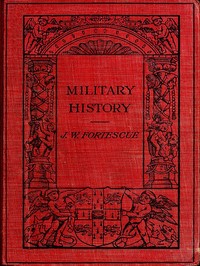
Military History: Lectures Delivered at Trinity College, Cambridge — Edition Insights
Edition facts
Fortescue opens his first lecture by confessing that when asked to define military history, he found it 'very difficult to furnish a satisfactory answer.' This admission sets the tone for a series that treats war not as a sequence of battles but as a problem of logistics, geography, and human will. Across four lectures, he repeatedly returns to the same theme: that 'transport and supply were the great difficulties' in every campaign he examines. His method is comparative and blunt, contrasting the American Revolution unfavorably with the Boer War, and insisting that naval supremacy—even on inland lakes—determined success in North America and the West Indies.
Definition by Difficulty
Fortescue begins not with a textbook definition but with a personal struggle: 'I was obliged for the first time to ask myself seriously, What is military history?' He rejects the easy answer—'the history of wars and warring'—and instead proposes that war is 'an instrument of policy for the imposition of the will of one community upon another by force of arms.' Yet he immediately complicates this by noting that 'force of arms is a very vague term.' The lecture then pivots to Napoleon's inability to attack England after 1805, illustrating that naval power and geography constrain even the most ambitious commander. Fortescue's approach is to define by example, not by abstraction.
The American Revolution Reassessed
Fortescue's treatment of the American Revolution is deliberately provocative. He argues that the British strategy to secure the Hudson River line was sound because 'the question of subsistence was at the root of the whole matter'—the American army's cereal and meat supplies were separated by the river. He then asserts that the Americans 'would never have beaten us without the help of the French' and that they 'were not in earnest,' wanting 'other people to do their fighting for them.' The comparison with the Boer resistance is explicit: 'it is impossible to regard the American rebellion with any great respect.' This is not balanced history; it is a pointed argument about national will and the role of foreign intervention.
Waterways as Decisive Terrain
In both the War of 1812 and the West Indian campaigns, Fortescue emphasizes that 'transport and supply were the great difficulties on both sides.' In North America, 'the main fighting took place on the waterway of the great lakes, simply because that was the only quarter in which either side could feed even a small army.' Success depended entirely on 'naval supremacy on the lakes.' For the West Indies, he notes that 'naval superiority is essential to every successful campaign' because islands require sea-borne troops and stores. His descriptions of the Antilles—'volcanic formation, mountainous,' with 'cultivation generally being confined to the lower hills and valleys'—ground the strategic analysis in physical geography.
The Author's Voice and Method
Fortescue writes with a confident, sometimes combative tone. He uses direct address ('you see'), rhetorical questions, and blunt judgments. His preface reveals that he publishes the lectures 'unwillingly, and in deference only to the wishes of some of my audience.' He also acknowledges inconsistency in spelling Indian names, wryly noting that he will plead guilty until 'the form Kalkáta is substituted for Calcutta.' This personal, occasionally defensive voice gives the lectures the character of an extended argument rather than a neutral survey. The reader is invited to follow a seasoned historian thinking through his subject in real time, with all the biases and provocations that entails.
Fortescue's lectures reward readers who attend to his recurring emphasis on logistics, geography, and naval power rather than expecting a balanced narrative. His judgments are sharp and his comparisons deliberate; the book is best approached as a series of arguments about what military history should study, not as a comprehensive account. Readers familiar with British colonial campaigns will recognize the contours of the events he discusses, but the value lies in watching a historian test his own definition of his field against concrete cases.